Ultrasonic HF boost in DN3600, caused by the transformer?

Chris Nixon

Junior
Jul 23, 2012
299
0
0
Northern Ireland
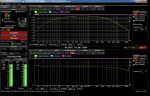
I've been measuring my DN3600, partly to measure it and partly to get to know Systune. I don't know if you can set SMAART to show frequencies beyond 20K, but Systune did by default and I noticed a large HF boost starting at around 23K, with a kind of "corner" at 23.35K and rising I don't-know-how-far because 24K is the Nyquist frequency of my interface.

This stumped me for a while, then I remembered reading something about transformers in a publication by Radial. I checked the service manual for the DN3600 and it has an output transformer! The manual is for the DN3600C while mine is a "B".

The interface is a Duo Capture EX, I tried connecting to the mic inputs to see if the impedance difference affected the behavior of the transformer but I didn't see any change. Would the impedance change need to happen before the transformer to see a change?

How far would this rise be expected to extend, what might it look like it I could see all of it? The DN3600 has a relay bypass when power is removed. When turned off this lift is still present but is less pronounced.

Am I on the right track here, are there any other interesting things I should try?

Thanks,

Chris
 

Attachments

  • DN3600 HF Lift.png
    DN3600 HF Lift.png
    105.6 KB · Views: 0
Last edited:
Re: Ultrasonic HF boost in DN3600, caused by the transformer?

I've been measuring my DN3600, partly to measure it and partly to get to know Systune. I don't know if you can set SMAART to show frequencies beyond 20K, but Systune did by default and I noticed a large HF boost starting at around 23K, with a kind of "corner" at 23.35K and rising I don't-know-how-far because 24K is the Nyquist frequency of my interface.

This stumped me for a while, then I remembered reading something about transformers in a publication by Radial. I checked the service manual for the DN3600 and it has an output transformer! The manual is for the DN3600C while mine is a "B".

The interface is a Duo Capture EX, I tried connecting to the mic inputs to see if the impedance difference affected the behavior of the transformer but I didn't see any change. Would the impedance change need to happen before the transformer to see a change?

How far would this rise be expected to extend, what might it look like it I could see all of it? The DN3600 has a relay bypass when power is removed. When turned off this lift is still present but is less pronounced.

Am I on the right track here, are there any other interesting things I should try?

Thanks,

Chris
Have you measured just your interface? i.e. out->in? If the HF signal is still there with the unit off, it's coming from somewhere else. Are you using a laptop? Have you tried running on battery while measuring? Switching power supplies can do interesting things, and many laptop supplies are known to be pretty cruddy.
 
Re: Ultrasonic HF boost in DN3600, caused by the transformer?

It's a dual channel transfer function, any problem that was common to both interface channels wouldn't show up in the measurement. I tried taking the XLR's out of the EQ and connencting them directly together, perfectly flat trace.

The signal is coming from the noise generator in Systune and being routed to both line outputs on the interface. One is connected directly back to an input to function as a reference and the other is the same but with the EQ in the loop.

Chris
 
Re: Ultrasonic HF boost in DN3600, caused by the transformer?

I've been measuring my DN3600, partly to measure it and partly to get to know Systune. I don't know if you can set SMAART to show frequencies beyond 20K, but Systune did by default and I noticed a large HF boost starting at around 23K, with a kind of "corner" at 23.35K and rising I don't-know-how-far because 24K is the Nyquist frequency of my interface.

This stumped me for a while, then I remembered reading something about transformers in a publication by Radial. I checked the service manual for the DN3600 and it has an output transformer! The manual is for the DN3600C while mine is a "B".

Hey Chris, two things:
1) Smaart will take measurements up to the Nyquist point of your interface sampling rate, most people use Smaart for PA work so anything past 20kHz (or really 16kHz!) is not meaningful.
2) Are you sure you don't have the measurement and reference swapped? I would expect to see a rolloff from a transformer, not a rise - and the shape past 23.3kHz doesn't make any sense at all. If you put in an EQ boost on the DSP does it show as a boost or a cut?
 
Re: Ultrasonic HF boost in DN3600, caused by the transformer?

Thanks,

Just checked again, a boost is a boost, a cut is a cut. I initially assumed it was the interface doing some sort of weird anti aliasing technique but the trace is flat when I plug the XLR's together, which it would be.

Here's the Radial doc. On page 3 they mention "rise due to output transformer" on the BSS and KT.

http://www.radialeng.com/pdfs/Radial-BlueReport-on-DIs.pdf

Chris
 
Re: Ultrasonic HF boost in DN3600, caused by the transformer?

I've just measured my own AR133, albeit with 6M of cable rather than the 100M Radial used. In the low end my measurements are pretty much identical, but the high end is basically flat. Is the difference in output cable length responsible for the difference in HF response? If so, is it caused by the transformer or by the cable?

Chris
 
Re: Ultrasonic HF boost in DN3600, caused by the transformer?

Here's the manual: The circuit diagrams are from page 33 onwards if anyone wants a look.

This is an analog audio path with digital control.

Chris
 

Attachments

Re: Ultrasonic HF boost in DN3600, caused by the transformer?

I'll post back later with more detail, but I AM getting the same shape of curve without the EQ in the loop, but with much less of a boost.

Part of my issue may be that I'm using two outputs with the "same" test signal rather than splitting one.

Chris
 
Last edited:
Re: Ultrasonic HF boost in DN3600, caused by the transformer?

Have you measured just your interface? i.e. out->in?

I should have paid more attention to this... :blush:

I'm getting measurements that don't seem logical, I'm just going to post them here and see if anyone can make sense of it.

I disconnected power, audio and VGA, none of that made any difference.

I'm using a Lenovo X201T running a trial version of SysTune V1.3.7. The trial is time limited but fully functional.

The interface is a Roland Duo Capture EX which is bus powered. I'm using the TRS I/O. Master output level is all the way up and input levels are at 12 O'clock, which gives the same level in as was sent out.

My cabling is a 6.4M 8 channel effects loom with TRS connectors on one end and MM,FF,MM,FF XLR on the other. I'm using the first four channels. TRS on interface end, XLR on test end.

The measurement channel is Interface output 1 connected to loom channel 1 which is connected to the input of the device under test. DUT output is connected to loom channel 3, which goes to interface input 1. In this case the DUT is the meas channel, XLR's connected together.

The reference channel is Interface output 2 connected to loom channel 2 which is connected to loom channel 4 (by joining the XLRs), which goes to interface input 2.

Here are the traces produced from connecting the meas and ref channels differently. Note that the scales are not all the same. In all scenarios swapping meas and ref channels inside SysTune inverts the trace.

Measurement 1: Connected as described above.

Measurement 2: Meas and Ref channels swapped at the interface inputs, trace is different, but still has the same lift in the HF.

Measurement 3: Starting from scenario 1, Meas and Ref channels swapped at interface outputs. Trace still shows a lift, but the very highest part is falling instead of rising.

Maybe my expectations are wrong, but this seems weird. This is the same shape of lift I had with the DN3600 in the meas channel, but with only about a 10th of the boost.

Comments?

Chris
 

Attachments

  • Measurement 1.png
    Measurement 1.png
    118.4 KB · Views: 0
  • Measurement 2.png
    Measurement 2.png
    117.2 KB · Views: 0
  • Measurement 3.png
    Measurement 3.png
    117.2 KB · Views: 0
Re: Ultrasonic HF boost in DN3600, caused by the transformer?

Hey Chris,

My guess is the behavior you're seeing past 22kHz is due to smoothing, or some error that forces bits the interface can't provide to have a value, and doesn't actually exist. Eliminate that and the result makes much more sense. Then ZOOM OUT. You're looking at tenths of a dB and fractions of a degree of phase! Nobody cares about that except in instrumentation, and if you're measuring electronics don't use Systune.
 
Re: Ultrasonic HF boost in DN3600, caused by the transformer?

Thanks Bennett,

You're right of course, if it isn't inverting when I swap input channels it basically can't be valid data. I'm still intrigued as to exactly why it's showing what it is, and why it's exaggerated with the EQ in the loop.

For the actual purposes of these measurements, looking at the differences between a DN3600 and a DN9344E, I'm happy to ignore anything over 20K (and most things after the decimal point) so a "here be dragons" approach will work. :razz:

I'm just getting into measurement so I decided to start out with electronic measurements so there'd be less scope for getting stuff wrong and misinterpreting the measurement. There goes that idea...

Chris
 
Re: Ultrasonic HF boost in DN3600, caused by the transformer?

Bennett's right. Make the scale on the magnitude display 10dB instead of 0.3dB and you will see a more reasonable result.

Mac